You’ve Got a Shiny AI Hammer—But Are You Hitting the Right Nails in Analyzing Unstructured Data?
Transforming unstructured call data into actionable insights with Large Language Models
Introduction
You can count your calls, but can you truly understand them?
In the ever-evolving landscape of customer service and operations, businesses are sitting on a goldmine of unstructured data: call transcriptions. These conversations between customers and agents contain rich insights about customer needs, pain points, and experiences—yet most organizations are barely scratching the surface of what they can learn from them.
By the end of this article, you'll move beyond merely tracking call data to deeply understanding why your customers interact the way they do, enabling more strategic, informed decisions.
Enter Large Language Models (LLMs), such as GPT-4, Claude, and other advanced AI systems. These powerful models are revolutionizing how we can analyze and extract insights from unstructured text data. Unlike traditional natural language processing techniques, LLMs can understand context, nuance, and implicit meaning in human conversations.
Call transcription analysis represents a particularly compelling use case for LLMs. Customer service calls are complex interactions involving multiple stakeholders with different intentions. They contain invaluable information about product issues, customer satisfaction, and operational effectiveness—all of which can directly impact a company's bottom line.
Traditional methods of call analytics—keyword spotting, basic sentiment analysis, and manual call review—often fall short. They provide surface-level metrics but struggle to uncover the deeper "why" behind customer interactions. As businesses seek to become more data-driven and customer-centric, these limitations are becoming increasingly apparent.
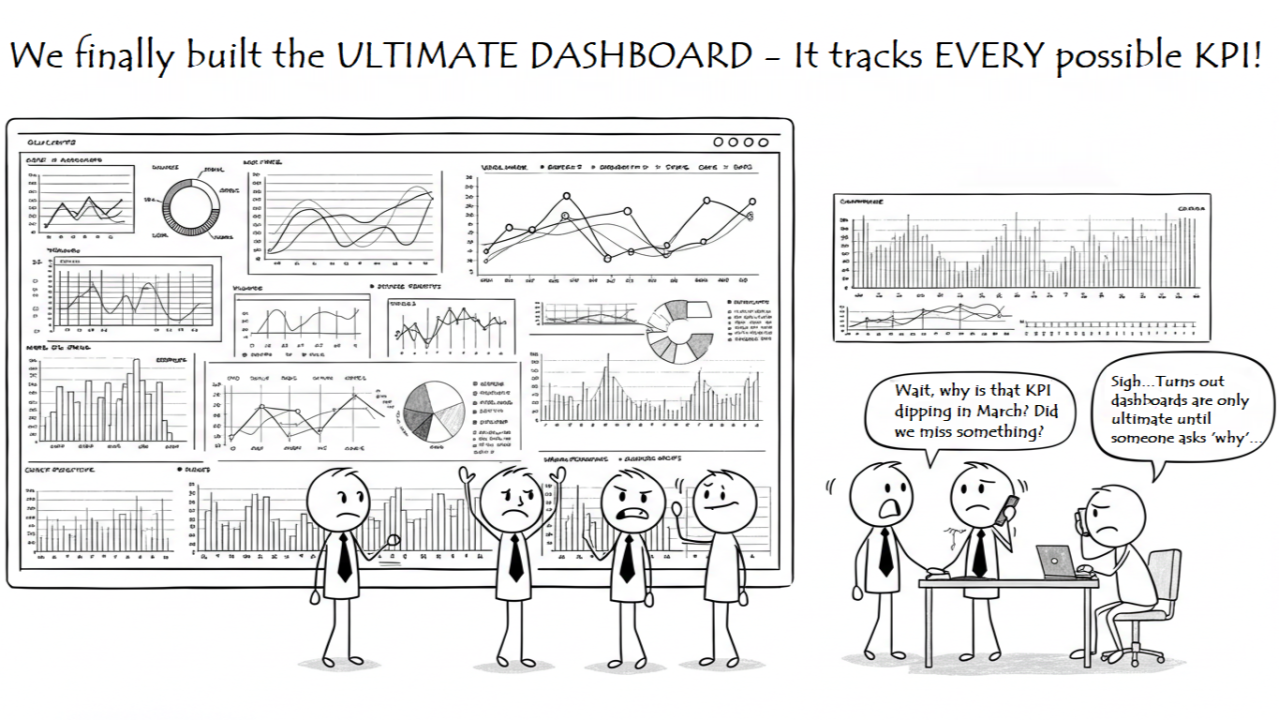
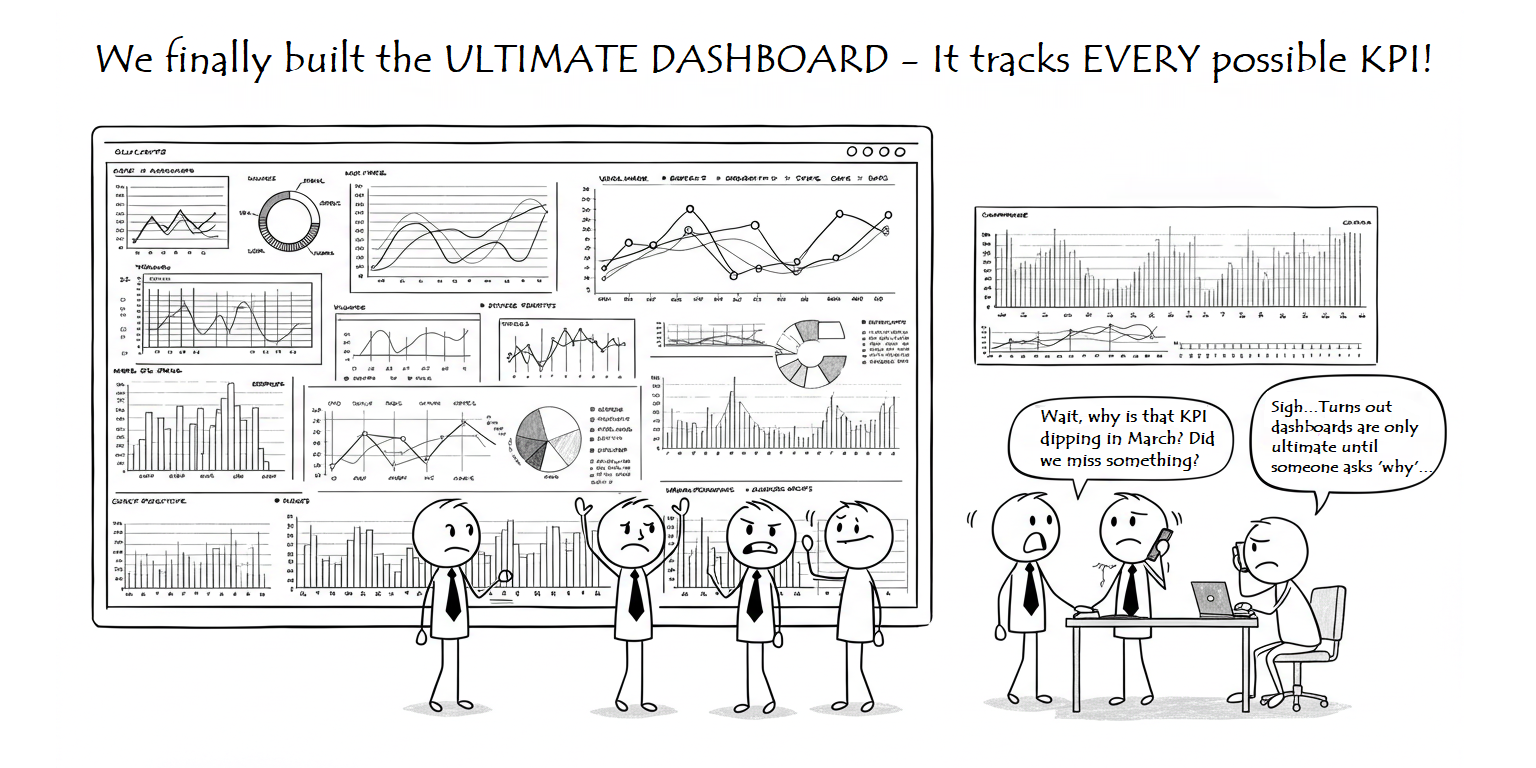
The comic in the image below illustrates the overwhelming yet untapped potential of customer call data—something many organizations experience firsthand.
The Problem Space: Why Traditional Call Analytics Falls Short
Current Limitations
Most traditional call analytics focus on surface metrics that are easy to measure but offer limited strategic value:
- Call volumes: How many calls are coming in, but not why they're occurring
- Handle times: How long calls take, without context about complexity or resolution quality
- Basic categorization: Simple bucketing of calls into predefined categories, missing the nuanced reasons behind them
- Transfer rates: How often calls move between departments, without explaining root causes
- Repeat call rates: Identifying when customers call back, but not analyzing why their issues weren't resolved
These metrics give operations managers numbers to track, but they don't provide the insights needed to drive meaningful improvements. For example, one company noticed rising repeat calls about billing. Traditional metrics showed the spike but no solution. With LLM analysis, they pinpointed ambiguous billing statements causing confusion, resolving the issue proactively and significantly reducing repeat calls
Missing Context
The most significant shortcoming of traditional call analytics is their inability to capture the "why" behind customer interactions. When a customer calls repeatedly, traditional analytics will flag the pattern but won't reveal:
- What specific issue remains unresolved
- Why the previous solution didn't work
- What product or process needs improvement to prevent future calls
Similarly, when call volumes spike for a particular issue, managers can see the increase but often have to manually review calls to understand the underlying cause—a time-consuming process that doesn't scale.
The Business Need
Organizations need deeper insights into their customer interactions to:
- Identify root causes of operational inefficiencies, not just their symptoms
- Understand customer intentions beyond simple categorization
- Evaluate agent effectiveness with context and nuance
- Drive strategic improvements based on clear patterns and insights
- Scale analytics across thousands or millions of interactions
Without these deeper insights, businesses are making decisions based on incomplete information, potentially missing opportunities to improve customer experience and operational efficiency. Now that we've established traditional methods' shortcomings, let's explore precisely how LLMs uniquely address these gaps.
Moving Beyond Simple Summarization
The Current State
LLMs offer call summaries and basic sentiment today—but is that really the full potential of this technology?
When organizations first begin exploring LLMs for call analysis, they typically start with basic summarization. Having an AI condense a 20-minute call into a few paragraphs certainly saves time compared to listening to recordings or reading full transcripts.
Some companies may also implement simple sentiment analysis to gauge customer satisfaction or agent performance. While these applications provide value, they still leave much of the potential of LLMs untapped.
Academic studies have shown that LLM-based systems for call summarization can cut down about 10% of call handling time while yielding more consistent summaries with fewer individual biases Call Summarization Research. Research also demonstrates that even smaller, domain-tuned 7B-parameter models can perform on par with larger models in terms of factual accuracy and completeness of summaries LLM Model Comparison for Call Analysis.
The Opportunity
LLMs offer the ability to extract structured insights from unstructured conversations. Rather than simply condensing information, they can identify patterns, relationships, and causal factors that drive customer experiences and operational outcomes.
Instead of just knowing that a customer was upset (sentiment) or what topics were discussed (summarization), companies can understand precisely what caused the customer's frustration and how effectively it was addressed.
Value Proposition
Moving beyond simple summarization delivers significant value across multiple business dimensions:
For Operations: - Identify specific process breakdowns causing customer friction - Understand which types of issues are most effectively resolved and why - Recognize emerging problems before they become widespread
For Agent Coaching: - Provide targeted feedback based on specific interaction patterns - Identify best practices from top-performing agents - Develop more effective scripts and resolution pathways
For Customer Experience: - Pinpoint exactly where and why customer journeys break down - Identify opportunities to proactively address common issues - Understand the full customer context, not just isolated interactions
By extracting these deeper insights, organizations can move from reactive reporting to proactive improvement.
Core Principles for LLM-Based Call Analytics
To effectively leverage LLMs for call analysis beyond basic summarization, organizations should understand several key principles:
Context Over Keywords
Think keyword-based call categorization truly captures what's happening on customer calls? Think again.
Unlike traditional keyword-based analytics, LLMs can understand the broader context of a conversation. They don't just identify when certain words appear but comprehend their significance within the interaction. For example, an LLM can distinguish between a customer mentioning a competitor as a threat to leave ("I'm considering switching to Company X") versus a passing reference.
Structured Analysis from Unstructured Data
LLMs excel at converting messy, natural conversations into structured data that can drive decision-making. They can extract specific data points (product mentions, issue types, resolution methods) while preserving the relationships between these elements—something traditional analytics often miss.
Flexible and Adaptive Understanding
Customer service conversations rarely follow a predictable script. LLMs can adapt to the natural flow of human dialog, recognizing when conversations shift topics or when issues are resolved indirectly. This flexibility allows for more accurate analysis of real-world customer interactions.
Balance Between Consistency and Nuance
Effective LLM implementations strike a balance between delivering consistent, reliable outputs and capturing the subtle nuances in human communication. This involves carefully designed prompting strategies, potential fine-tuning for specific domains, and appropriately configured model parameters.
LLM sentiment analysis can provide a more nuanced view of customer emotions compared to traditional methods, detecting degrees of positivity or negativity in feedback rather than simple binary classifications Sentiment Analysis Using LLMs Explained.
First Steps Toward Implementation
Have we finally found the right analytics tool—or are we treating every problem as a nail because we have an LLM-shaped hammer?
For organizations looking to move beyond basic call summarization with LLMs, here are practical starting points:
Define Clear Business Objectives
Start by identifying specific business problems you want to solve: - Are you trying to reduce repeat calls? - Do you need to identify product issues earlier? - Are you looking to improve agent training and effectiveness?
Having clear objectives will guide your implementation and help measure success.
Assess Data Readiness
Evaluate your current call transcription quality and availability: - Do you have accurate transcripts of customer calls? - Is your data properly stored and accessible? - Are there privacy or compliance considerations to address?
High-quality input data is essential for meaningful LLM analysis. As noted by AWS, "having accurate transcripts is the first step to generating useful call summaries and insights" AWS: Increasing Agent Productivity Through Automated Call Summarization.
Start with Focused Use Cases
Rather than attempting to analyze everything at once, begin with specific, high-value scenarios: - Analyze calls related to a particular product feature or issue - Focus on understanding resolution patterns for common problems - Identify factors contributing to customer escalations
These focused applications can deliver quick wins while building expertise.
Establish Evaluation Methods
Develop clear methods to validate the accuracy and usefulness of LLM outputs: - Compare LLM analyses with expert human reviews - Measure improvements in key metrics (repeat calls, resolution times) - Gather feedback from end-users of the insights
Continuous evaluation ensures your implementation remains aligned with business needs. Companies implementing LLM-based analytics often monitor outputs for anomalies and set up feedback loops to quickly correct any issues Generative AI Use Case: Assurance.
Future Horizons
Finally, we'll explore emerging possibilities in LLM-based call analytics:
Advanced Applications Beyond Basic Analysis
What if you could detect customer complaints before they overwhelm your call centers?
The future holds exciting possibilities for deeper analysis: - Techniques for root cause analysis and pattern detection - Approaches to agent performance scoring and personalized coaching - Methods for predicting customer behavior and enabling proactive interventions
Operational Integration and Scaling
As implementations mature, integration becomes crucial: - Strategies for connecting LLM insights with CRM systems - Approaches to balancing computational costs with business value - Methods for processing high call volumes efficiently
Real-time Implementation: From Post-Call to In-Call
You've got a shiny AI hammer—but are you hitting the right nails?
The ultimate evolution moves from historical to real-time analysis: - Transitioning from post-call analysis to in-call guidance - Technologies enabling agent assistance during customer interactions - Ethical considerations and implementation strategies
Leading companies are already implementing real-time capabilities. For example, Nubank, a large digital bank, developed a "Call Center Copilot" that integrates with their knowledge base to assist agents during customer interactions, resulting in 2.3× faster resolution times with higher accuracy Nubank: Transforming Customer Support with GPT-4.
Conclusion
Traditional call analytics provide useful metrics but often miss the deeper insights hidden within customer conversations. By leveraging Large Language Models, organizations can move beyond simple summarization to uncover the "why" behind customer interactions, identify root causes of operational challenges, and drive strategic improvements.
The journey from basic call metrics to sophisticated LLM-based analytics requires both technical expertise and organizational alignment. It involves navigating challenges related to model consistency, prompt design, and integration with existing systems. However, the potential rewards—improved customer experience, operational efficiency, and strategic decision-making—make this a worthwhile endeavor for forward-thinking organizations.
The future of call analytics lies not just in counting and categorizing interactions but in truly understanding them. By embracing the power of LLMs, organizations can transform call centers from cost centers into strategic assets that drive business growth and customer satisfaction.
Upcoming Articles in This Series
- Managing LLM Output Consistency: Can You Trust Non-Deterministic LLMs for Classification?
- Balancing Specificity and Generalization in Prompts: Can Your Prompts Serve Multiple Business Lines Effectively?
- Quantifying Qualitative Insights: How Do You Turn Qualitative Data into Actionable Metrics?
- Strategic Choices: Prompt Engineering vs. Fine-tuning: Prompt Engineering or Fine-tuning: Which Strategy Wins?
- Navigating Stakeholder Alignment: Who Needs to Align to Make AI Analytics Successful?
- Strategic Build vs. Buy Decisions: Build or Buy: What's Best for Your AI Analytics?
- Change Management for Successful AI Adoption: Can You Get Your Organization Ready for AI-driven Change?
- From Post-call Analysis to In-call Guidance: From Post-call to Real-time Analytics: How Close Are We?
References
- Call Summarization Research - Academic research on LLM-based call summarization systems
- LLM Model Comparison for Call Analysis - Study showing domain-tuned 7B models performing competitively with larger models
- Sentiment Analysis Using LLMs Explained - How LLMs provide nuanced sentiment analysis beyond traditional methods
- AWS: Increasing Agent Productivity Through Automated Call Summarization - AWS on the importance of accurate transcription for meaningful analysis
- Generative AI Use Case: Assurance - How Assurance IQ implemented LLM-based call scoring with continuous evaluation
- AWS Bedrock Inference Parameters - Technical guidance on controlling LLM output variance
- Discover Financial Services Deploys Google Cloud's Generative AI - Case study on implementing generative AI in customer service
- Nubank: Transforming Customer Support with GPT-4 - How Nubank achieved faster resolutions with AI-assisted agents