How to Design LLM-Powered Expert Decision Applications: The Conceptual Framework
Introduction
"The most dangerous phrase in business today might be 'Let the AI decide'—until you've defined exactly what decisions it should make and how consistently it should make them."
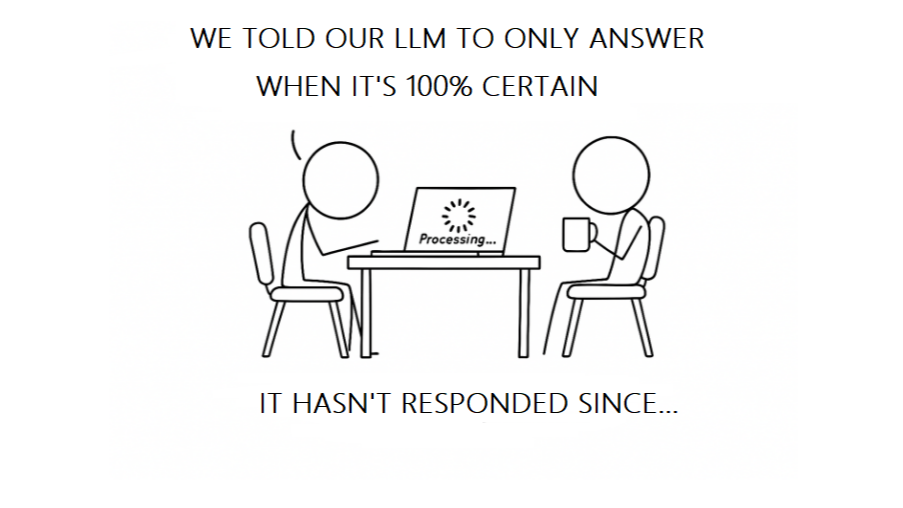
Imagine this scenario: Your customer support AI confidently issues a $200 service credit to a disgruntled customer on Monday. Then on Tuesday, presented with an almost identical case, it denies any compensation. By Friday, it's inexplicably placing new product orders without customer consent. Sound like a nightmare?
That's the reality many organizations face when deploying large language models for customer service operations. While LLMs have burst onto the scene as remarkably powerful reasoning tools, their inherent unpredictability creates unique challenges. When your business serves millions of customers, even small inconsistencies become massively expensive problems—a mere 2% error rate in unnecessary $200 credits across a million customer interactions translates to $4 million in avoidable costs.
Here's a more balanced approach: While we can't completely eliminate LLM non-determinism, we can strategically manage it. The art lies in knowing where to draw hard boundaries and where some variability remains acceptable. In this article, I'll share a practical framework for mitigating the highest-risk aspects of LLM-powered expert applications while still leveraging their powerful capabilities. We'll develop a nuanced understanding of where consistency matters most—focusing our control efforts on classifications that trigger consequential operational decisions while allowing controlled flexibility elsewhere.
After reading this article, you'll walk away with:
- A decision framework for identifying where LLM variability poses real business risks - Jump to Types of Variability
- A practical approach for implementing appropriate consistency controls based on operational impact - Jump to Action-Driven Framework
- A resource allocation model that strategically invests in consistency where it matters most - Jump to Consistency Budget
In short, you'll gain the conceptual tools to balance necessary reliability with the contextual understanding that makes LLMs valuable for repeatable, scalable expert decision applications. In part two of this series, we'll explore specific implementation strategies and techniques to put these concepts into practice.
Understanding LLM-Powered Decision-Making
The Challenge of Non-Determinism
Here's the thing about LLMs that keeps many executives up at night: ask them the same question twice, and you might get two different answers. This non-determinism stems from their model architecture, input ambiguity, context sensitivity, and diverse training data.
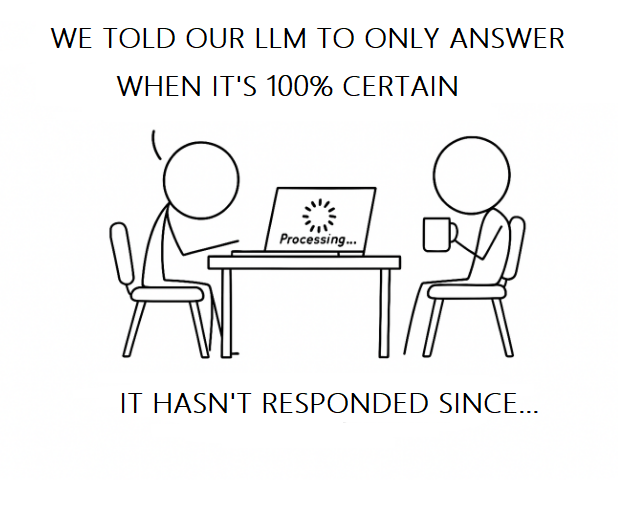
This unpredictability becomes particularly thorny in expert domains like medicine, law, education, and customer service. In these fields, decisions rarely boil down to simple yes/no choices. Instead, they involve sophisticated reasoning that blends expertise, context, ethics, and human values.
This reality forces us to rethink what "correct" even means. Rather than chasing some mythical perfect answer, we need to focus on establishing reasonable boundaries of acceptable judgment—just like human experts do.
Types of LLM Variability
Not all LLM randomness is created equal. There are actually two distinct types you need to recognize:
- Surface Variance (Harmless Randomness): Think of this as your LLM rephrasing the same core idea differently—like saying "We should proceed with the treatment plan" versus "I recommend moving forward with the proposed treatment." Same meaning, different words.
- Semantic Divergence (Deep Unpredictability): This is the dangerous kind—where your model flip-flops between fundamentally different recommendations, like "Approve the loan application" versus "Reject the loan application."
Knowing which type you're dealing with helps determine whether you need to act. Surface variations? Probably fine. Semantic divergences? Those demand your attention—and fast.
Have you examined your LLM outputs to identify which type of variability is most prevalent in your systems? The distinction could significantly impact your approach to managing non-determinism.
Framing Expert Decisions Clearly
The Role of Problem Formulation
Here's a secret that too many teams miss: most LLM unpredictability isn't a model problem—it's a prompt problem. The way you frame questions dramatically impacts consistency. Want more reliable outputs? You need thoughtful problem formulation through:
- Clearly defining the scope and constraints
- Specifying the exact format and structure you need
- Providing relevant context and examples
- Thinking through the operational implications of different responses
The quality of your prompt engineering directly influences the reliability of your LLM outputs. As we transition from theoretical understanding to practical application, let's examine how this plays out in a real-world scenario.
Real-World Example: Call Resolution Classification
Let me show you this in action. Imagine you're building a system to evaluate whether customer service agents are resolving issues effectively.
Most teams would start with something like this:
Ambiguous Formulation:
Classify whether the agent resolved the customer issue.
Seems straightforward, right? But this vague prompt ignores critical nuances that will lead to wildly inconsistent results.
Compare that with this improved version:
Improved Formulation:
Classify whether the agent made sufficient effort to resolve the customer issue, considering:
1. Company-wide policies and external events that are beyond agent control
2. Customer sentiment throughout the call (not just closing phrases)
3. Whether agent actions were appropriate given the available options
4. Compliance with required protocols or escalation procedures

A case is classified as "insufficient effort" ONLY if ALL of the following are true:
- The issue was within the agent's control to address
- Clear solution options existed that were not pursued
- The agent failed to follow required procedures
- No appropriate escalation was attempted when needed
See the difference? This precise formulation creates guardrails that dramatically reduce variation between runs. Your prompt isn't just a question—it's the foundation of consistency.
Defining Operational Boundaries
The Action-Driven Approach
Now that we understand the importance of clear problem formulation, let's explore how to translate this into practical operational boundaries. Here's where the rubber meets the road: in business, what ultimately matters isn't the LLM's exact words—it's whether those words trigger different operational actions with real financial implications.
Think about it this way: if your model sometimes describes a customer as "frustrated" and other times as "dissatisfied," but both descriptions lead to the same customer service response, who cares? That's harmless variability.
But what if one day your model recommends remote troubleshooting and the next day suggests dispatching a $300 on-site technician visit for the exact same issue? Now we're talking about variability that hits your bottom line.
For classifications that trigger resource-intensive actions, even small inconsistency rates translate to big money—a mere 5% rate of unnecessary technician dispatches could cost you millions annually in a large operation.
The Action-Driven Framework: A Practical Approach
So how do you tackle this challenge head-on? By designing classification systems around the operational actions they trigger:
High-Cost Actions: Apply your strictest controls to classifications that trigger expensive interventions.
For example, require 95%+ confidence scores before recommending a technician dispatch and implement hierarchical decisions that exhaust remote options first. When actions differ significantly in cost, your consistency requirements should scale accordingly.
Customer Education Classifications: Ensure rock-solid consistency in information disclosure.
Always flag conversations where customers should be informed about potential charges and reliably identify when representatives fail to set proper expectations. Consistent information sharing builds trust and prevents those dreaded "surprise" billing complaints.
Predictive Maintenance Trade-offs: Find the sweet spot between preventing future problems and addressing immediate needs.
Consistently identify when equipment is approaching end-of-life versus experiencing a temporary glitch. These predictions require both consistency and nuanced understanding.
This action-focused approach concentrates your engineering resources where they'll deliver the biggest ROI—on classifications with substantial operational and financial impact.
Which operational actions in your business carry the highest financial impact when LLMs make inconsistent decisions? Identifying these high-stakes decision points is your first step toward effective non-determinism management.
Real-World Case Study: Customer Support Channel Optimization
Let me share how we applied these principles to optimize customer support channels for a telecommunications company. While this example is based on a hypothetical scenario with approximated figures to protect confidential information, it illustrates the practical application of our framework using realistic industry metrics.
The Challenge: The company was struggling with high variability in how agents and AI systems classified technical issues. This inconsistency resulted in unnecessary escalations to phone support and technician dispatches—their most expensive support channels—for issues that could have been resolved through chat or self-service.
Our Approach: We implemented an LLM-powered classification system to analyze customer issues and determine the most appropriate resolution channel, applying our action-driven framework:
- Issue diagnosis accuracy: We applied strict consistency controls to the core technical diagnosis process, as misdiagnosis directly triggered high-cost technician visits. We focused on accurately identifying which technical issues required physical intervention versus which could be resolved remotely.
- Channel routing decisions: For routing between chat support, phone support, and field service, we implemented confidence thresholds based on the cost difference between channels. Higher confidence was required to route to more expensive channels.
- Self-service opportunity detection: We tuned the system to consistently identify opportunities where customers could resolve issues independently with proper guidance.
ROI Insight: For organizations supporting 10 million customers where service delivery involves expensive touchpoints like field technician visits, optimizing decision pathways with LLM-powered classification systems could potentially save $50-60 million annually. Interested in building a comprehensive ROI model for your own organization? Stay tuned for our upcoming article on translating LLM outputs into quantifiable business metrics that will convince even the most skeptical stakeholders.
The "Consistency Budget" Framework
With our action-driven approach in mind, let's now consider how to allocate your resources effectively. Think of consistency like a limited budget you need to allocate wisely across your system. Not every component deserves the same investment:
- High-Consistency Requirements: Spend heavily on aspects with significant operational consequences, like medical diagnosis or credit approval classifications
- Moderate-Consistency Requirements: Make reasonable investments where consistency matters but some variation is acceptable, like generating support documentation
- Lower-Consistency Requirements: Save your budget on areas where creative variation actually adds value, such as ideation or suggesting alternative approaches
Let's see how this might play out in a real business context:
Consistency Budget Allocation Example: Healthcare Decision Support
A healthcare provider implementing an LLM system to support clinical workflows might allocate their consistency budget as follows:
High Investment (80% of budget) focuses on areas with direct patient safety implications. This includes medication dosage recommendations where precise amounts are critical to avoid adverse reactions, critical lab result interpretations that might indicate life-threatening conditions requiring immediate intervention, and diagnostic classifications for acute conditions where treatment decisions depend directly on accurate categorization. These high-stakes decisions warrant the strictest consistency controls because errors could lead to serious harm.
Moderate Investment (15% of budget) addresses patient communication and care coordination needs. This encompasses patient education material generation which should be consistent in medical accuracy but may vary in presentation style, discharge instruction summaries that balance standardization with personalization based on patient circumstances, and follow-up recommendation timing that requires reasonable consistency but allows for clinical judgment. These areas benefit from some standardization while permitting contextual adaptation.
Low Investment (5% of budget) supports areas where creative variability actually enhances outcomes. This includes bedside manner coaching for clinicians where personalized approaches based on individual communication styles are valuable, alternative treatment brainstorming that benefits from diverse thinking and novel approaches, and patient engagement content where varied presentation keeps materials fresh and engaging. In these domains, enforcing rigid consistency could actually diminish effectiveness.
This allocation doesn't mean the low-investment areas are unimportant—rather, it recognizes that creative variability in these areas might actually be beneficial, while consistency in high-investment areas is absolutely critical for patient safety.
Are you spending your consistency budget wisely, or are you trying to enforce uniform determinism across your entire system? The latter approach is not only computationally expensive but often counterproductive, as it limits the LLM's ability to provide creative, contextually rich outputs where appropriate.
By strategically investing your consistency budget, you'll achieve reliability where it matters most while preserving the beneficial aspects of controlled flexibility elsewhere.
Conclusion
We've explored the conceptual foundations necessary for designing effective LLM-powered expert decision applications:
- Understanding the distinct types of LLM variability and which ones actually matter
- Recognizing the critical role of precise problem formulation in reducing unwanted randomness
- Designing classification systems around operational impacts rather than semantic nuances
- Allocating your consistency resources strategically based on business criticality
Key Takeaways: - Focus consistency controls on decisions with significant operational and financial impact - Allocate your "consistency budget" strategically—not all variations are equally harmful - Frame problems precisely with clear boundaries and explicit criteria - Identify which decision points trigger fundamentally different operational actions
In Part 2: Implementing LLM-Powered Expert Decision Applications, we'll dive into the practical implementation strategies, technical approaches, and organizational considerations to put these concepts into action. You'll learn specific techniques for temperature optimization, structured outputs, human-in-the-loop frameworks, and cross-functional collaboration that will bring these principles to life in your organization.
Remember, the goal isn't to eliminate all variability—it's to control it where it matters most while preserving the creative, contextual understanding that makes LLMs valuable in the first place.
Related Articles in This Series
- You've Got a Shiny AI Hammer—But Are You Hitting the Right Nails in Analyzing Unstructured Data? - Explores how LLMs can transform call center analytics by moving beyond simple summarization to extract deeper contextual insights
- Implementing LLM-Powered Expert Decision Applications: Practical Strategies (Part 2 of this artile)
- From Text to ROI: Quantifying the Business Impact of LLM-Powered Decision Systems (Coming Soon) - Learn how to translate complex LLM implementations into compelling financial metrics, with ROI calculation frameworks for multiple industries and stakeholder communication strategies that win executive buy-in